
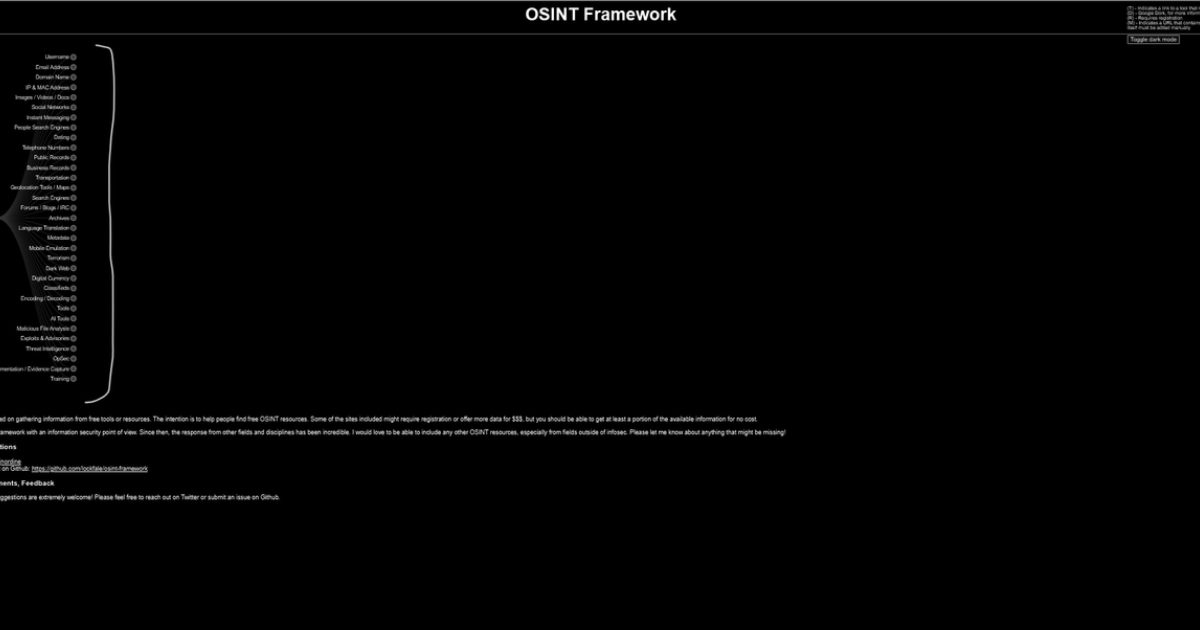
OSINT Framework: turning a username into a footprint
A handle is the cheapest thing a person leaks, and the most expensive thing to ignore. I had one Discord username, shulkwisec, and nothing else. The tree at osintframework.com turned that string into a set of accounts on other services, pages that mention the name, and a personal site.
OSINT, shortened: using research skill against information that is already public to pull out something useful. The information being public is the constraint that shapes the work. The search skill is the work.
What the framework is
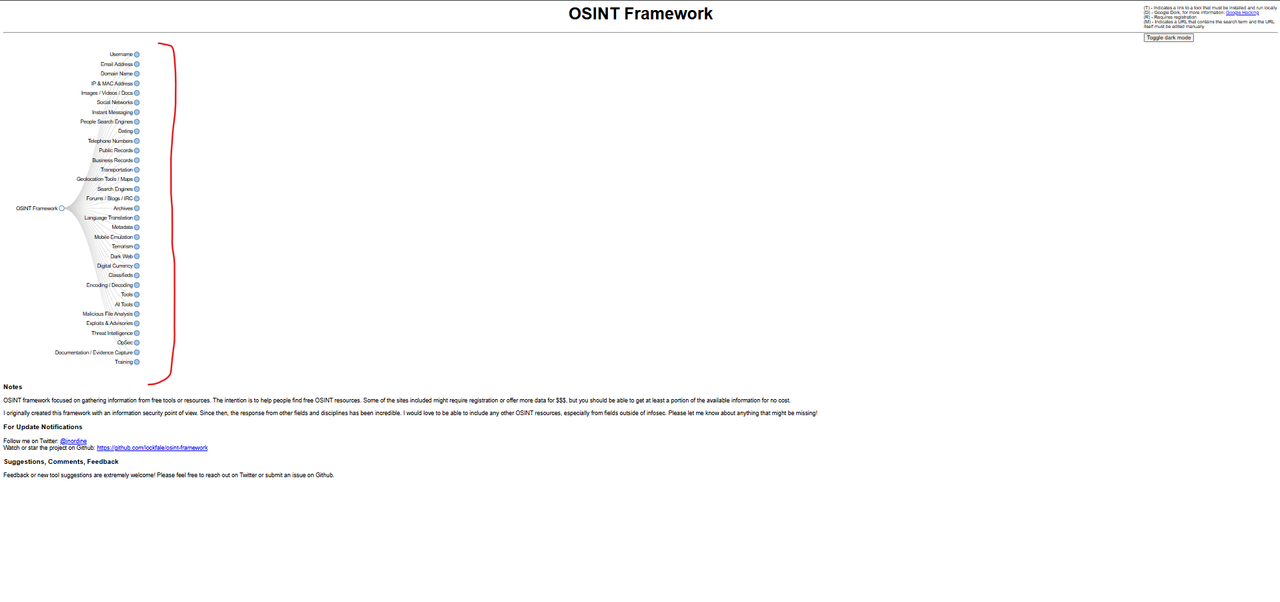
A directory of tools, laid out as a tree and sorted by classification. Each branch answers one question: given this kind of artifact, where do I go next. The Username branch, for example, holds every tool in the collection that takes a username and returns something about it. The other branches hold the same thing for the other artifact types.
That is all it is. A map of leaves, most of them pointing at a single external tool or search page.
The value is that it starts from the artifact and walks down to the tool. A search engine returns a thousand “OSINT tools” pages and none of them tell you which one fits the string in your hand.
Walking the Username branch
The target was a person I knew only by a Discord handle. No email, no real name, no phone number, no profile URL. One string.
The move is to pick the branch that matches the artifact I have, then take a tool from it. Under Username, the one that fit was WhatsMyName: it checks a handle against a long list of services and reports where the handle exists, which is exactly the part nobody wants to do by hand.
The run came back with three kinds of hit: accounts on other services, articles that mention the name, and a personal site. The screenshots of that run lived on signed Discord links that have since expired, so what is written here is what the tool returned, not a picture of it.
The part that is not collection
A handle is not a person. Two accounts with the same string can belong to two different humans, and the tool cannot tell you which is which, because it only compares text.
What I have from that run is a set of pages that contain the string. What I do not have is proof that all of them belong to the same person. The check is separate from the collection: take a second artifact from one hit, a linked site or a display name or a bio, and see whether it appears on the others. A hit that cannot be tied to a second artifact stays a hit, not a finding, and the framework has no step that does this for you.
One tree, many readers
The same collection serves people who would never call themselves researchers:
- Ordinary users, often without knowing the name for it: hunting a leak, a stream, a news item, a book.
- Pentesters and security teams: recon on an organization or a person before an engagement, and a clear view of what an attacker can already see.
- Law enforcement and intelligence services: investigations, tracking, threat analysis.
- Journalists: verifying a claim and documenting an event from social media content.
- Companies: media monitoring, competitor research, consumer preference, reputation.
- Marketing and business analysts: market and competitor trends.
- Geopolitical researchers: conflict data from satellite imagery and public reporting.
Every one of them starts from an artifact and walks a branch. State intelligence agencies and criminals work from the same public pages.
What to take from this one
The framework is a decision tree, and the decision is always the same: what do I actually have. Write that down before opening any tool. “A username” and “a username plus an email” are different branches with different leaves, and guessing sends you to a tool that cannot use your input.
The method, in the order it worked:
- Start from the artifact, not from the goal. The goal was “find this person”; the artifact was a Discord handle. The artifact is the only part that picks a branch.
- Take the tool from the branch. This is where a curated tree earns its place, because the tool is chosen for the input type rather than for its reputation.
- Treat each hit as a new seed. An account carries a display name, a bio, a linked site. Those are new artifacts, so the run goes back through the branch instead of stopping at the first table.
- Keep the provenance. Record which tool produced which hit, so that a bad branch can be cut without redoing the run.
- Verify after collecting, never during. A matching string is a lead. A second independent artifact agreeing with the first is the start of a finding.
The next target will not be a Discord handle. The loop is the same whatever the artifact is: an email address, a domain, a phone number. Put the artifact in your hand, find the branch that matches it, take the tool the branch offers, and write down how you got from one hit to the next. The record is what makes the second pass cheap when a hit turns out to be someone else.
Related posts
03 ENTRIES


https://shulkwisec.github.io/02-Research/osint-framework-by-shulkwisec/
Printed 2026-11-15